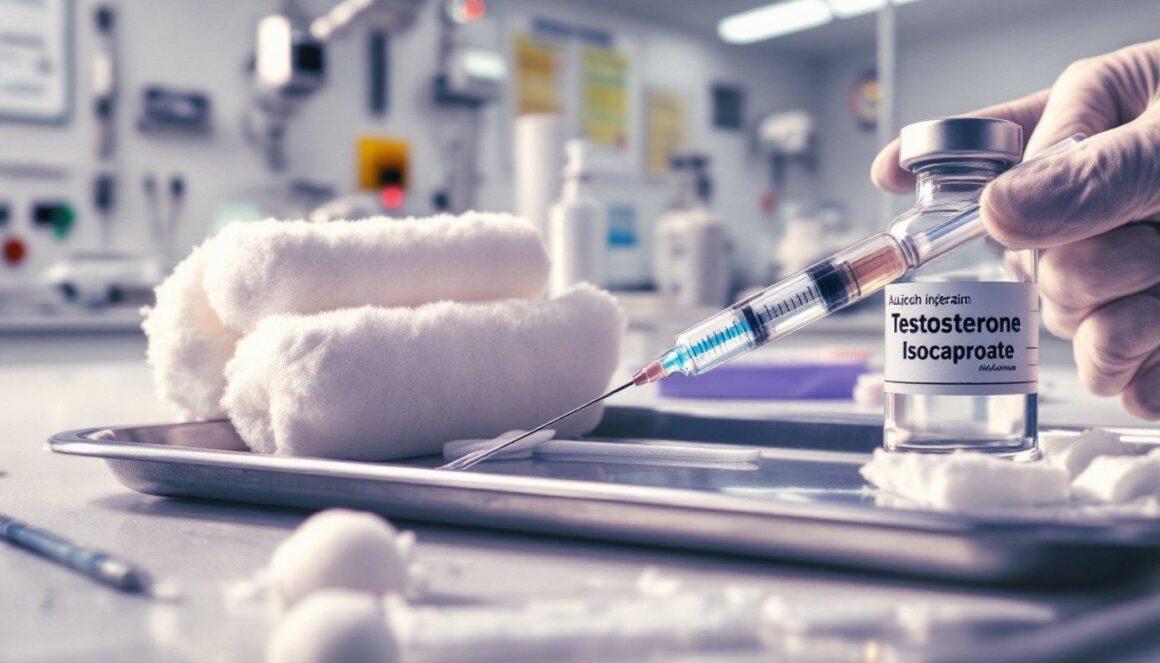
Testosterone isocaproate is a medium-acting ester of testosterone best known as one of the four testosterone esters found in Sustanon 250. In bodybuilding, it attracts attention for the same fundamental reasons as other forms of testosterone: supporting muscle growth, strength, recovery and overall anabolic activity.
What makes testosterone isocaproate different is not the hormone released after the ester is removed. The active hormone is still testosterone. The isocaproate ester mainly changes how quickly testosterone is released from the injection site and how long the preparation remains active.
That distinction is central to understanding testosterone isocaproate for bodybuilding.
The ester influences timing, testosterone produces the anabolic effects.
What Is Testosterone Isocaproate?
Testosterone isocaproate is testosterone attached to an isocaproate ester.
Esterification changes the physical properties of testosterone and allows an oil-based intramuscular preparation to release the hormone gradually rather than all at once.
After release, enzymes cleave the ester from the molecule, leaving biologically active testosterone.
This means testosterone isocaproate ultimately works through the same androgen receptor pathways as testosterone propionate, enanthate, cypionate or decanoate.
The main difference between these preparations is pharmacokinetic. They release testosterone at different rates.
Testosterone isocaproate is particularly well known because it appears in Sustanon 250 alongside testosterone propionate, testosterone phenylpropionate and testosterone decanoate. The current licensed Sustanon formulation contains 60 mg of testosterone isocaproate per millilitre as part of the four-ester blend.
For bodybuilders, the isocaproate ester therefore sits between very short and very long testosterone esters in terms of release characteristics.
Testosterone Isocaproate for Bodybuilding: Why Is Testosterone So Popular?
Testosterone has remained one of the most recognized anabolic hormones in bodybuilding because its effects on skeletal muscle are well established.
Research in healthy men has shown that increasing testosterone exposure can increase fat-free mass, muscle size and strength. Controlled studies have also demonstrated a dose-responsive relationship between testosterone concentrations and changes in lean mass and muscle performance.
This gives testosterone a much stronger evidence base than many designer steroids or older prohormones.
For bodybuilding, the main areas of interest include:
- increased lean muscle;
- improved muscular strength;
- greater training capacity;
- improved muscle retention;
- enhanced body composition;
- fuller muscles from increased glycogen and intracellular water;
- improved recovery from demanding resistance training.
Those are testosterone effects generally rather than unique properties of the isocaproate ester.
That point is important.
Testosterone isocaproate is not a different anabolic hormone from testosterone enanthate or testosterone propionate once the ester has been removed.
Muscle Growth and Lean Mass
The biggest reason for interest in testosterone isocaproate for bodybuilding is muscle growth.
Testosterone acts through androgen receptors found in skeletal muscle and influences processes involved in muscle protein accretion, muscle-fibre hypertrophy and maintenance of lean tissue.
Controlled research has demonstrated that testosterone administration can increase muscle cross-sectional area and fat-free mass.
One landmark trial involving resistance-trained men found that testosterone combined with strength training produced substantially greater gains in fat-free mass, muscle size and strength than training alone.
Separate research has shown that testosterone-related increases in muscle size involve actual hypertrophy of muscle fibres rather than simply changes in fluid balance.
That is particularly relevant for bodybuilding.
A larger measurement on the scale does not necessarily mean more muscle.
Testosterone’s anabolic action can contribute to genuine increases in lean tissue when combined with sufficient training and nutrition.
Testosterone Isocaproate and Strength
Strength improvements are another major reason testosterone is used in strength and physique sports.
Testosterone exposure has been associated with increases in maximal voluntary strength and muscular power. Research has found that these changes can increase with greater testosterone exposure, alongside gains in lean mass.
For a bodybuilder, increasing strength can indirectly support muscle development.
Progressive resistance training depends on repeatedly providing the muscles with enough mechanical tension to stimulate adaptation.
If an athlete becomes stronger, heavier loads or greater training volumes may become possible.
Over time, that can contribute to the conditions required for hypertrophy.
This is why testosterone isocaproate for bodybuilding is generally discussed in terms of both muscle size and performance rather than appearance alone.
Why the Isocaproate Ester Matters
Once testosterone reaches the bloodstream and the ester is cleaved, testosterone is testosterone.
The ester primarily controls release.
Shorter esters tend to leave the injection depot more rapidly.
Longer esters generally remain available for longer.
Testosterone isocaproate sits in the middle of this spectrum.
That intermediate character is one reason it is useful in a mixed-ester preparation such as Sustanon.
In Sustanon 250, the mixture combines testosterone propionate, phenylpropionate, isocaproate and decanoate. The intention of such a formulation is to provide overlapping release profiles rather than relying on a single ester.
From a bodybuilding perspective, the attraction of the isocaproate ester is therefore mainly its pharmacokinetic profile.
It is not inherently more anabolic than the testosterone released from another ester.
Testosterone Isocaproate vs Testosterone Propionate
Testosterone propionate has a shorter ester.
That generally means testosterone is released more rapidly and the preparation has a shorter duration of action.
Isocaproate has a longer ester structure and therefore produces a more prolonged release profile.
Bodybuilders sometimes interpret this as one being stronger than the other.
That is not quite correct.
The underlying hormone is identical.
What changes is how rapidly that hormone becomes available.
Once the ester has been removed, testosterone propionate does not produce one kind of testosterone while testosterone isocaproate produces another.
Both produce testosterone.
The practical distinction is timing.
Testosterone Isocaproate vs Enanthate
Testosterone enanthate is one of the most familiar standalone testosterone esters used in medicine and discussed in bodybuilding.
Isocaproate has a broadly intermediate release profile and is most commonly encountered as part of a mixed preparation rather than as a mainstream standalone pharmaceutical.
The anabolic effects expected from either ultimately come from testosterone.
This means differences in muscle growth are more closely related to total testosterone exposure, hormone concentrations, training and nutrition than to some unique muscle-building property of the ester itself.
Clinical and experimental studies involving testosterone enanthate clearly demonstrate testosterone’s ability to increase lean mass and strength, which provides useful evidence for understanding the anabolic action of testosterone as a hormone.
There is considerably less bodybuilding-specific research examining isolated testosterone isocaproate.
Testosterone Isocaproate and Sustanon
For many bodybuilders, the most familiar encounter with testosterone isocaproate is through Sustanon.
Sustanon 250 was developed as a mixed testosterone preparation.
Its currently licensed formulation contains:
30 mg testosterone propionate;
60 mg testosterone phenylpropionate;
60 mg testosterone isocaproate;
100 mg testosterone decanoate.
The total amount of actual testosterone after accounting for the ester weights is 176 mg per millilitre.
The idea behind combining several esters is straightforward.
The shorter esters begin releasing testosterone more rapidly, while the longer components contribute more prolonged release.
Testosterone isocaproate occupies the middle portion of that release spectrum.
This is why discussions of testosterone isocaproate for bodybuilding frequently overlap with discussions of Sustanon.
Muscle Fullness and Bodybuilding Appearance
Testosterone does more than simply increase contractile muscle tissue.
Bodybuilders often notice changes in overall muscular fullness as well.
Part of this can relate to glycogen storage, intracellular water and the greater amount of lean tissue being carried.
Testosterone also has effects on sodium and water balance. Licensed Sustanon information notes that testosterone can increase sodium, potassium and chloride retention and may increase water retention.
This does not mean all weight gained while using testosterone represents water.
Rather, bodybuilding appearance can reflect several simultaneous changes:
actual muscle hypertrophy;
greater muscular glycogen;
intracellular fluid;
changes in extracellular fluid;
and changes in body fat.
This is why scale weight alone gives an incomplete picture of bodybuilding progress.
Testosterone Isocaproate During Muscle-Building Phases
The anabolic profile of testosterone naturally makes testosterone isocaproate for bodybuilding most closely associated with periods focused on gaining muscle and strength.
When calorie intake and protein are sufficient, anabolic signaling and resistance training work toward the same overall goal: increasing lean tissue.
Testosterone research demonstrates that higher androgen exposure can produce measurable increases in fat-free mass and muscle size.
Nutrition remains essential.
Testosterone cannot replace sufficient calories, protein or progressive training.
Its bodybuilding relevance comes from improving the physiological environment in which adaptation takes place.
That is very different from simply adding calories and expecting the same result.
Testosterone Isocaproate During Cutting
Testosterone is also relevant when the bodybuilding goal changes from gaining mass to reducing body fat.
During a calorie deficit, maintaining lean tissue becomes one of the primary concerns.
Research under severe energy-deficit conditions has shown that testosterone can help preserve or even increase lean body mass compared with placebo, although this type of controlled study does not directly replicate a bodybuilding contest preparation.
This explains the interest in testosterone during physique-cutting phases.
The goal is not that testosterone directly burns large amounts of body fat.
Instead, its anabolic properties can support lean tissue while nutrition creates the calorie deficit responsible for fat loss.
That distinction is important.
Testosterone isocaproate for bodybuilding is better understood as anabolic support than as a fat-burning drug.
Testosterone and Body Recomposition
Body recomposition means improving the relationship between muscle and fat.
A bodybuilder can remain close to the same body weight but look noticeably different if lean mass increases while fat mass decreases.
Testosterone has biological effects that make this relevant.
Clinical testosterone therapy in hypogonadal men has been shown to increase lean body mass and decrease fat mass, while controlled research in healthy men has demonstrated clear increases in fat-free mass at higher testosterone exposures.
The magnitude and context differ between medically indicated treatment and bodybuilding use, but the underlying body-composition effects help explain testosterone’s long-standing popularity in physique sports.
Recovery and Training Capacity
Recovery is difficult to measure because bodybuilders use the word to describe several things at once.
It can mean less muscle soreness.
Better performance in the next training session.
Maintaining higher weekly training volume.
Or simply recovering enough to train the same muscle group again.
Testosterone’s anabolic effects on skeletal muscle provide a biological basis for its association with improved recovery and training capacity.
That does not mean soreness disappears or that recovery becomes unlimited.
Muscles, connective tissues, sleep and the nervous system still require appropriate management.
From a bodybuilding standpoint, the value lies in supporting adaptation to demanding resistance training rather than eliminating the need for recovery.
Is Testosterone Isocaproate Better Than Other Testosterone Esters?
Not necessarily.
This is probably the most important point in understanding testosterone isocaproate for bodybuilding.
The isocaproate ester does not create a uniquely anabolic form of testosterone.
The ester modifies release.
After cleavage, the active hormone is still testosterone.
Therefore, a claim that testosterone isocaproate automatically produces more muscle than testosterone enanthate, cypionate or another ester would be difficult to justify.
Differences between testosterone esters matter primarily for pharmacokinetics.
Bodybuilding results depend much more heavily on overall androgen exposure, nutrition, resistance training, genetics, recovery and time.
Testosterone Isocaproate for Bodybuilding: Main Benefits
The bodybuilding interest in testosterone isocaproate ultimately reflects the established anabolic properties of testosterone.
The main benefits associated with testosterone-based bodybuilding use include:
Lean muscle development: testosterone supports increases in fat-free mass and muscle-fibre size.
Strength: controlled studies demonstrate increased strength and power with greater testosterone exposure.
Training performance: increased strength can help support progressive resistance training.
Muscle retention: anabolic activity can help preserve lean tissue during periods of reduced calorie intake.
Body recomposition: testosterone can shift body composition toward greater lean mass.
Muscular fullness: muscle tissue, glycogen and fluid changes can contribute to a fuller bodybuilding appearance.
What is specific to isocaproate is primarily the release profile.
The muscle-building mechanism remains testosterone.
Testosterone Isocaproate for Bodybuilding: The Bottom Line
Testosterone isocaproate is a medium-acting testosterone ester most famously included in the four-ester Sustanon 250 formulation.
Its role is easy to misunderstand.
The isocaproate ester does not fundamentally change what testosterone does inside muscle. Instead, it changes how testosterone is released from the injection depot before the ester is removed and active testosterone becomes available.
That makes testosterone isocaproate for bodybuilding interesting primarily as a delivery form of one of the most extensively studied anabolic hormones.
Testosterone itself has strong evidence for increasing lean mass, muscle size and strength. Research also supports its ability to influence muscle-fibre hypertrophy and body composition.
For bodybuilders, that translates into the familiar goals of greater muscularity, improved strength, better lean-mass retention and support for body recomposition.
The isocaproate ester mainly determines the pace.
The bodybuilding effects come from testosterone itself.
That is the clearest way to understand testosterone isocaproate for bodybuilding and why the ester remains a recognizable component of mixed-testosterone preparations. Read more: https://supplements4muscle.com/en/module/blockblog/blog?post_id=366